
Quantcast

Path Of A Worldwide Launch, According To Game Localizer Binari Sonori

By Spencer . January 7, 2012 . 9:18pm

Localization gaps between Japan and the Western world have shrank in the past decade. Believe it or not, it used to take years for a Final Fantasy game (don’t even ask about Dragon Quest) to cross the Pacific Ocean. Final Fantasy XIII-2 will be released in North America and Europe just one month after its launch in Japan.


Binari Sonori helps companies like Square Enix, Capcom, Ubisoft, and Namco Bandai localize titles and manage multiple languages since 1994. Their goal is to "simship" or simultaneously ship games around the world. This photo, taken from a conference, shows their plan for localizing a game while its still in development.
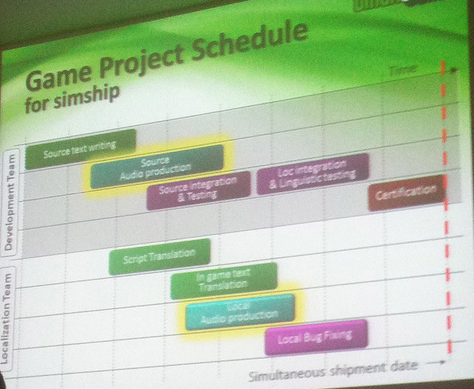

 

Path Of A Worldwide Launch, According To Game Localizer Binari Sonori


Read more stories about & & & on Siliconera.

  • http://twitter.com/DanijoEX DanijoEX

    Sounds good from what I read. 

    I really had never heard of Binari Sonori…

    • http://twitter.com/Haseosan87 Francesco

      Binari Sonori is a localization company born in Italy in 1994, but it also has branches in America and Asia. It is responsible of a lot of localization works especially in Italy and Europe.

  • http://twitter.com/Xander_VJ David García Abril

    Yeap, that’s a valid way to go if you want an international release.

    However, it has some serious problems.

    Translating while the original text is still changing (thing that happens ALL THE TIME during testing and implementation) forces the translators to change their own tex too. Or in other words, to re-translate… pretty much EVERYTHING.

    That makes the localization process longer, and hence, more expensive.

    However, the alternative is to wait until the original text is final… which doesn’t happen until the game itself is almost finished. And that makes the international release impossible, unless the Japanese version gets delayed because of it.

    The method Binari Sonori describes, however, is a method that can work for stablished franchises, like “Final Fantasy”.

    For new IPs… unless the developer has A LOT of faith in the game’s success… not so much.

    • http://tristsantithesis.tumblr.com/ Tsunayoshi Sawada

      What do you mean? Isnt the solution to that issue to have frequent communication with the writing staff or meetings, would they really be in a case in which they need to retranslate the entire source? That makes it sound like the game met some developmental hiccup that force the JPN staff to start all over again?  

      • http://twitter.com/Xander_VJ David García Abril

        When I say that the original text changes I don’t mean that they start over from scratch.

        I mean that they change a certain number of text cells (which can be text boxes, subtitles, dubbing lines, menu entries, etc), little by little. Sometimes they change a lot of cells in one day, sometimes just a small number of them. And normally many lines will be re-written (and hence, re-translated) more than once.

        It’s innevitable, since it’s the way of polishing the text.

        And no, having frequent communication with the writting staff, although it’s a HUGE help (things would be much worse if they hadn’t), doesn’t solve the issue.

        The thing is a translation can never be final if the original text isn’t. And that’s a problem for making the translations during develpoment.

        Again, this is something a big name can afford. But not so much a new IP, which needs to see first if it has success in Japan itself.

        • http://twitter.com/Haseosan87 Francesco

          You’re right. I have a friend who works as a voice actress at Binari Sonori, and she’s already been called two or three times to re-dub the same scenes. I won’t say from which game/s, but I can tell you they’re pretty important franchises. So yes, it’s a thing that just big companies can afford (and they often are the only ones who can localize in multiple languages).

  • Go2hell66

    Well thank god for companies like these, what would we do without them

Video game stories from other sites on the web. These links leave Siliconera.

Popular