


 By
By 
Milano’s Odd Job Collection is such a surprise that, once XSEED announced it was on the way, we had to reach out to learn how it happened. In addition to Ryuichi Nishizawa sharing insights into the original PS1 release, Implicit Conversions CEO Bill Litshauer also talked about what it was like for the studio to approach this title, get it working on modern devices with its emulator, and add additional quality-of-life features.
Jenni Lada: How long have you been working on Milano’s Odd Job Collection, and what made you decide, “This is a game that needs to appear everywhere on modern consoles?”
Bill Litshauer: The folks at Hilltop Works presented the idea to us in the spring of 2024. We all had a chance to play the original Japanese version of the game and fell in love with its charm.
It’s the type of game that stands the test of time: the pixel art and animation is beautiful; it’s a wholesome, casual, cozy game; and it has a lot of variety with the minigames and life-sim aspect. This felt like a perfect fit for the modern era. In fact, when we demoed it at Tokyo Game Show this year, people thought it was a newly made game! We had to show them that it was from 1999.
Another important note: Milano didn’t have complicated licensing issues to work around, which is always a consideration when we select a new title.
We started talking to XSEED Games about it in the early summer of 2024. Once we had an agreement in place, work began on the localization aspects of the game. Engineering work related to the tooling and localization started around September 2024, but the full-scale engineering work (integration into our PS1 emulator, Pancake) started in January of 2025.
What kinds of challenges did you face bringing Milano’s Odd Job Collection out of the PS1 era and into the modern one?
Litshauer: As with most titles from that era, the source code was not available and the game uses its own custom-built engine. This particular engine is “event-based”, which became more popular in later years. From a software archaeology perspective, it’s very interesting. It made the code a bit harder to reverse engineer, because this approach isn’t common in PS1 titles.
But the biggest challenges are always making sure the rights and the people who originally made the game are respected and honored. We were fortunate that XSEED Games/Marvelous USA were very thoughtful about this and it was always taken into consideration.
Did the localization present any sorts of challenges?
Litshauer: For Milano, we wanted all aspects to be localized, not just text.
In collaboration with Hilltop Works, the graphics were meticulously redone to match the game’s aesthetic while still being localized to English. We also added subtitles wherever it made sense. We were very fortunate to have the wonderfully talented Kayli Mills on board, so she re-recorded all the voice-over and music. It was very important to us to deliver a completely localized experience to the player.
From an engineering perspective, there were a few tricky spots in the game that were more challenging to localize. For example, the buttons and timing in Pop Star Power, the sorting of furniture names in the House menu, and a few instances where the English text was longer than the Japanese text.
The game has a very colorful and stylistic text that doesn’t like to follow any particular rules. As a result, we had to match every different little style that the game used. There was also no standard text encoding, so text had to be constructed raw from the PS1’s GPU commands.


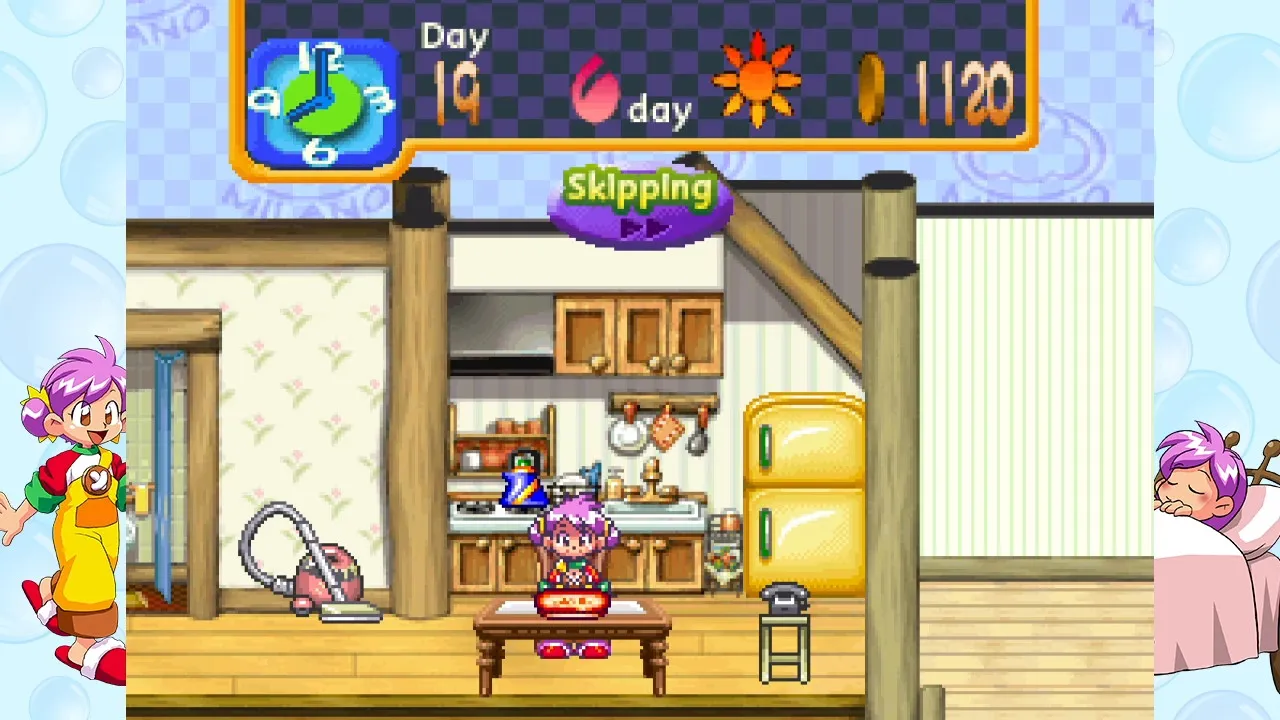
You added save states and a rewind option as gameplay quality of life features. How difficult were those to implement?
Litshauer: The good news: all games that use the Syrup Engine benefit from Save States, Rewind, and CRT shaders! These are baked into the system.
A few other quality of life changes we added were faster load times, a localized Syrup interface to Japanese, and pillarbox artwork to fill the blank space on either side (since the game was originally 4:3). And of course, we added achievements/trophies!
Were there any other quality of life adjustments that you wanted to consider, but couldn’t add?
Litshauer: We discussed a few improvements internally, but ultimately decided the game should retain its original charm. For example, there was a way to make the game widescreen, but it would have required some zooming and would have changed the “feel” of the game, so we opted not to include it.
In a perfect world, it would have been cool to add even more languages, like French, Italian, German, Spanish, etc.
Are there any other obscure 1990s games from Japan you’d want to work on and release worldwide?
Litshauer: There are many, so I’ll just stick to a few… Personally, I would love to see the 1989 NES game Sweet Home come to modern consoles. It’s an early survival horror and served as the precursor to the Resident Evil franchise. Bahamut Lagoon (similar to Final Fantasy Tactics) would be awesome because… dragons! Terranigma and Mother 3 would also be on the list!
Milano’s Odd Job Collection is on the Switch, Switch 2, PS4, PS5, Xbox One, Xbox Series X, and PC.