


 By
By 
Pengonauts is on a roguelike roll. StarVaders proved to be an engaging deck-building one. Now the follow-up Dicevaders involves careful unit placements and dice roll combos. Dicevaders is an engaging and entertaining addition to the genre, offering accommodations without watering down gameplay. However, I do wish the balance got a bit better on later levels, and it does feel less strategic than the team’s previous title.
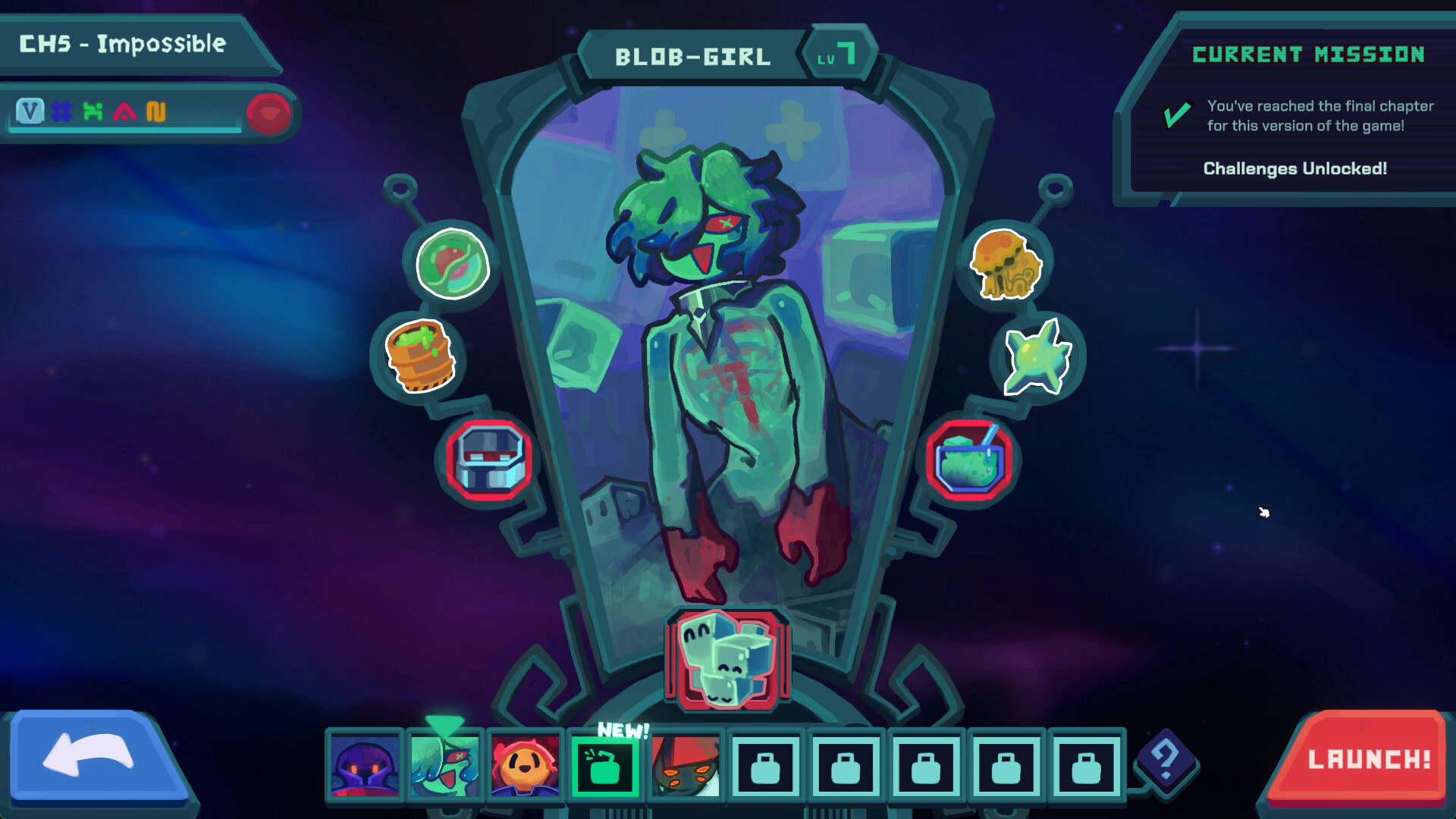
With Dicevaders, humans are the enemy. More specifically, the humans we played as in Pengonauts’ previous game StarVaders. (Don’t worry! This is a self-contained adventure!) Those beings devastated your forces, and it is time to make them pay by picking an alien commander and heading toward earth with forces, wiping out their Target Defenses each round with your Attack Power to decimate the solar system. With each run, you unlock things like new abilities, artifacts, and commanders, leading to more opportunities to destroy all humans.
Every Dicevaders run begins with a row of units divided into six columns, with a handful deployed and only a few spots unlocked. Each column corresponds to a face on a die, and there are spaces at the top of each for artifacts that can influence each round, all of a certain type of unit, or a particular column. Every stage consists of four turns and a Target Damage amount you must hit with your Total Attack. You must acquire, place, and arrange pieces of your army, unlock more spots and equipment, to ensure you hit those milestones and reach Earth.
There are also the typical influencing elements in Dicevaders. We get an innate ability we start with, gaining others after leveling up. Artifacts can be purchased in the shop between rounds with earned currency, doing things like providing buffs, rewarding you for certain units, and providing boons to the fighters in the row below them.
In some ways, it feels like Pengonauts is rooting for us with Dicevaders due to some design choices that offer us a little recourse against random luck. We can reroll the dice or shop as long as we have Chrono currency to do so, giving us chances at a better roll and offensive numbers. (You can freeze dice you want to keep at no cost.) It’s also possible to “bump” a die up or down, as long as it isn’t cracked or frozen, to give a nudge for a combo as long as you have the Budge currency. We get a few extra lives too, allowing for a chance to course correct if we are on the threshold of success.
All of which is helpful, as I sometimes feel like there’s a bit of a difficulty spike and balancing issue in Dicevaders. It sneaks up on you. Some of the pilots can possess staggering defensive numbers. So much so that even if you are adjusting your army and swapping out lower value ones for new ones, it can be literally impossible at certain points to hit that requirement even with the equipment we can buy, perks we get, and “help” from Pengonauts.
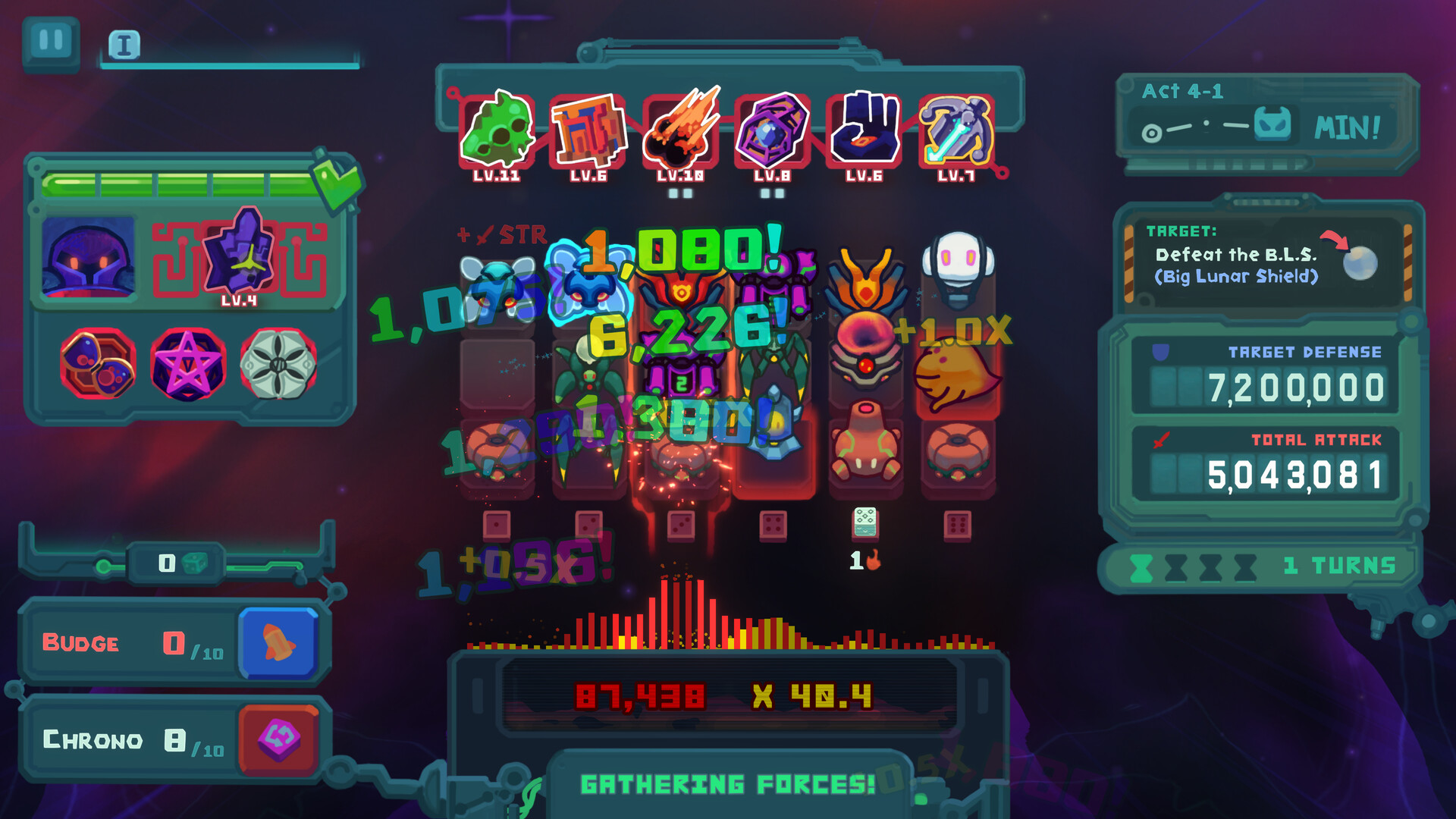
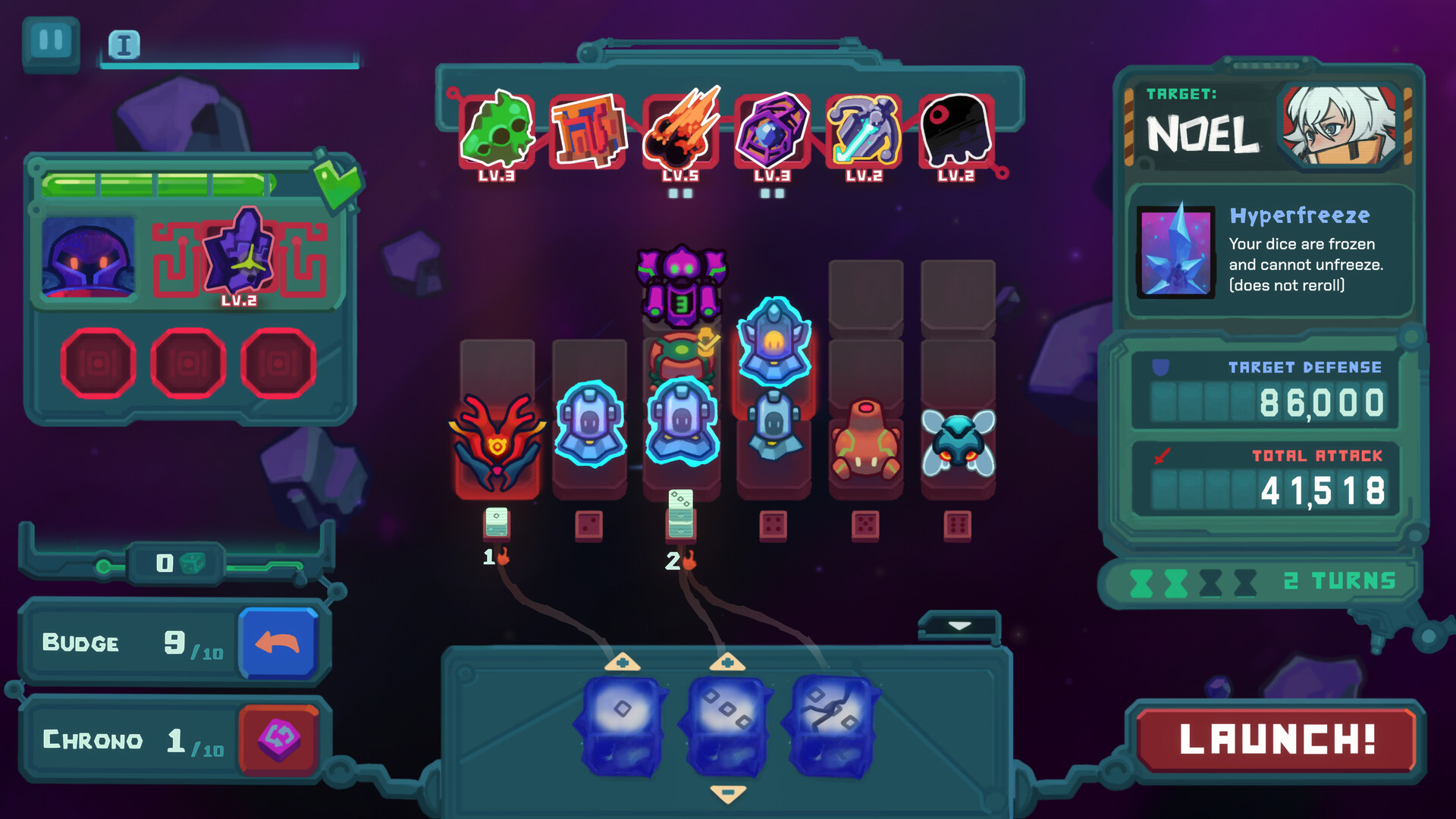
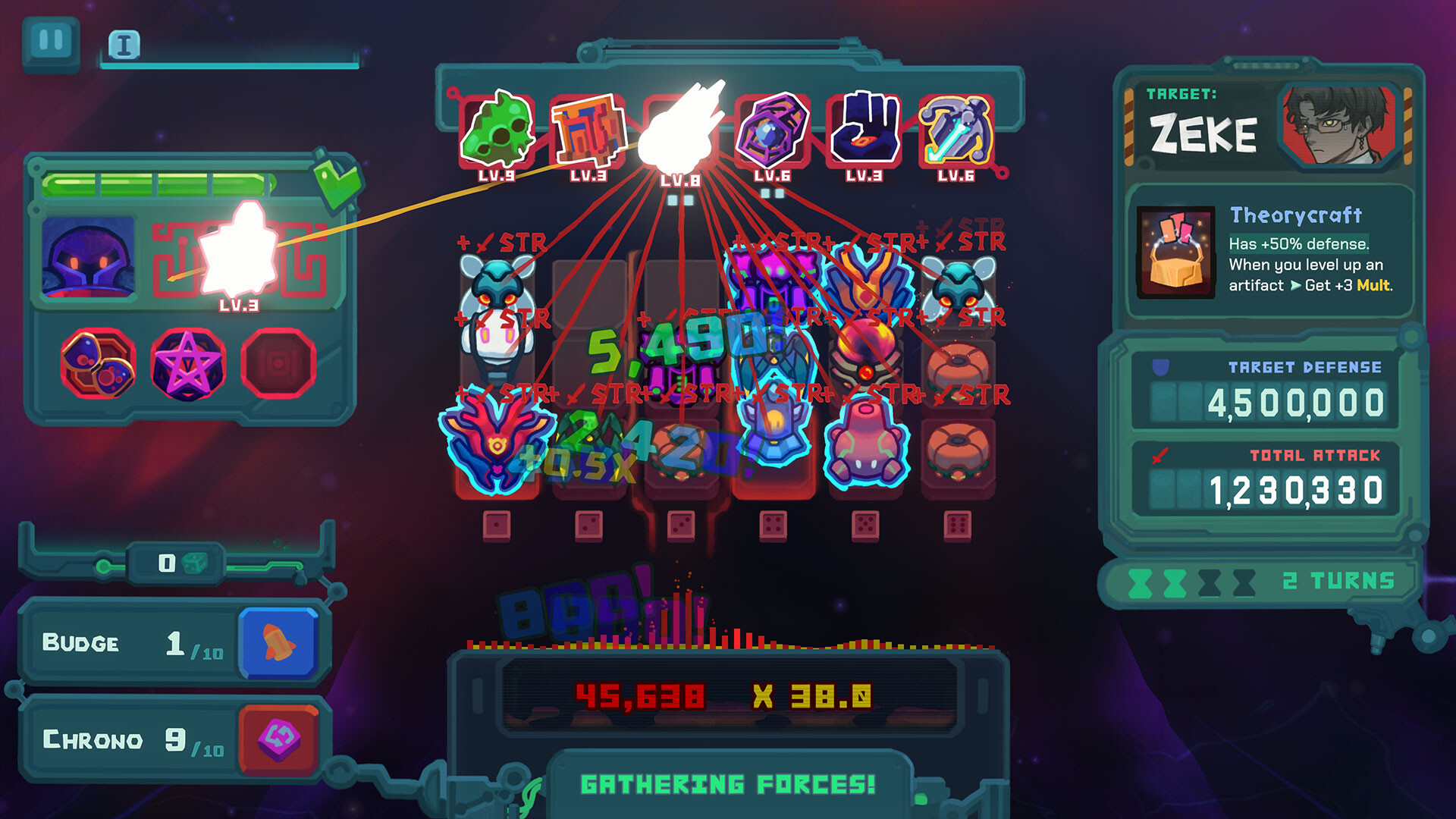
Without too many spoilers, the stage before one pilot boss had a 500,000 Target Defense that needed to be met in four turns. Then the very next node, the human showed up with a 4,500,000 Target Defense! Again, which needed to be hit and/or surpassed in four turns. That’s a massive jump! This sort of jump does happens with earlier bosses as well, with one run jumping from 14,000 Target Defense minimum one stage to a 86,000 one for the pilot in the round after. I found that feels less traumatic though, given how much easier it is to gain multiplayers that go from 2-3 thousand to 10 to 20 thousand. Since it can also be a bit difficult to check your multipliers until you really see how they play off each other in action, it might work against some folks until they’ve played for a few hours and “get” it.
I will also say that people who appreciated StarVaders for its more strategic depth and elements might not connect as well to Dicevaders. As you probably guessed from that balancing issue I suggest it has, this is very much a numbers-go-up game. You’re constantly going for big combos, keeping track of when artifacts level up for increased powers and cohesiveness, and if you need to destroy and swap out your units. Aside from choosing if you nudge or reroll dice, there isn’t the same degree of strategy as in Pengonaut’s previous game. There’s less engagement than we see in Balatro as well, and LocalThunk did a better job of conveying information I feel there too.
While in the same genre as StarVaders, Dicevaders still manages to feel unique and engaging in a different way. Especially since Pengonauts made efforts to help us fight back against the risks of RNG. I did find the difficulty spike toward the ends of runs to be jarring sometimes. Also, you should go in knowing this is all about big numbers. But for fans of the genre, it could turn into another way to spend 10 to 50 to 70 hours.
Dicevaders is on the Switch, Switch 2, and PC.