


 By
By 
What I love about games like Six Ages is how there are these emerging narratives, the management elements, and how, even if things seem like they start to get dire, maybe with some wise choices I can still pull through. They’re well-written and get me thinking about what different characters, resource handling, and alliances can offer. While Thousand Hells: The Underworld Heists definitely feels like A Sharp’s previous games in some ways, I feel like the degree of randomness inserted in the name of replayability hurts the formula.
While some of A Sharp’s other tales involved clans and their management, Thousand Hells is about one last big score. Even though we should retire, the promise of loot and glory makes the lure of one last journey through hell too irresistible. And so we make our character, pick up three randomized allies, and head off on a mission that will hopefully grant our desires.
Right from the start, we’re confronted with an array of choices showing how Thousand Hells is a different beast than something like King of Dragon Pass and Six Ages. We choose a mission, which can be random or something like “Field Research,” “Love Lost,” “The Profane Tragedy,” or “Skin Deep.” After picking a mission, we also select a Hell, with again a random option being possible or ones with foreboding names like The Great Below, The Hell of Nightmares, The Midnight North, and The Other Sun. Once you pick your Mission and Hell and start, the introduction lets you determine your profession and five traits by doing things like selecting your background, personal quality, and fault through visual novel style choices. (You also pick your name, pronouns, and portrait.) From there, you’ll also pick up random allies via recruiting.
Once you set out on the adventure, I found Thousand Hells can feel a bit more like a visual novel with Choose-Your-Own-Adventure elements than a management game or strategic simulation like A Sharp’s past works. Each character will have a profession and traits, which you can check during the recruiting process or will come up when making decisions. So someone might be a Natural Leader and Ingenious, or they might be Charismatic and Beautiful. You might come across a person who’d be a more practical choice since they are Literate and good at Woodlore. A person from the Picklock profession would likely have the Pickpocket and Lockpicking traits. A good rule of thumb, I found, is to feature a wide range of practical abilities, with things like beauty and charisma coming in handy.
From there, Thousand Hells sends you off to make (hopefully wise) choices using the skills you have. Some of this will involve research being done outside of the Hell by consulting individuals and places and choosing who will look into things. Once you happen upon encounters or situations, you’ll deal with scenarios that will show you your up to four wins and up to three losses. Those moments present you with three insights into what you’re dealing with. These could be traits an opponent possesses, weather conditions, other factors like additional beings around you, effects happening around you, time of day, and your own current conditions.
When this happens, you’ll see four possible courses of action below the descriptions that explain things you could do as a result of members of your party’s professions and traits. So you might have Past Dealings or Surprise Connection tied to someone you picked up. Being a Gambler could result in a quick game of chance. Pickpockets could use sleight of hand. Being Combat Trained could mean “sometimes violence is the answer.” A noble background could result in Regal Bearing influencing results. Being Careless or Stressed could also mess things up.
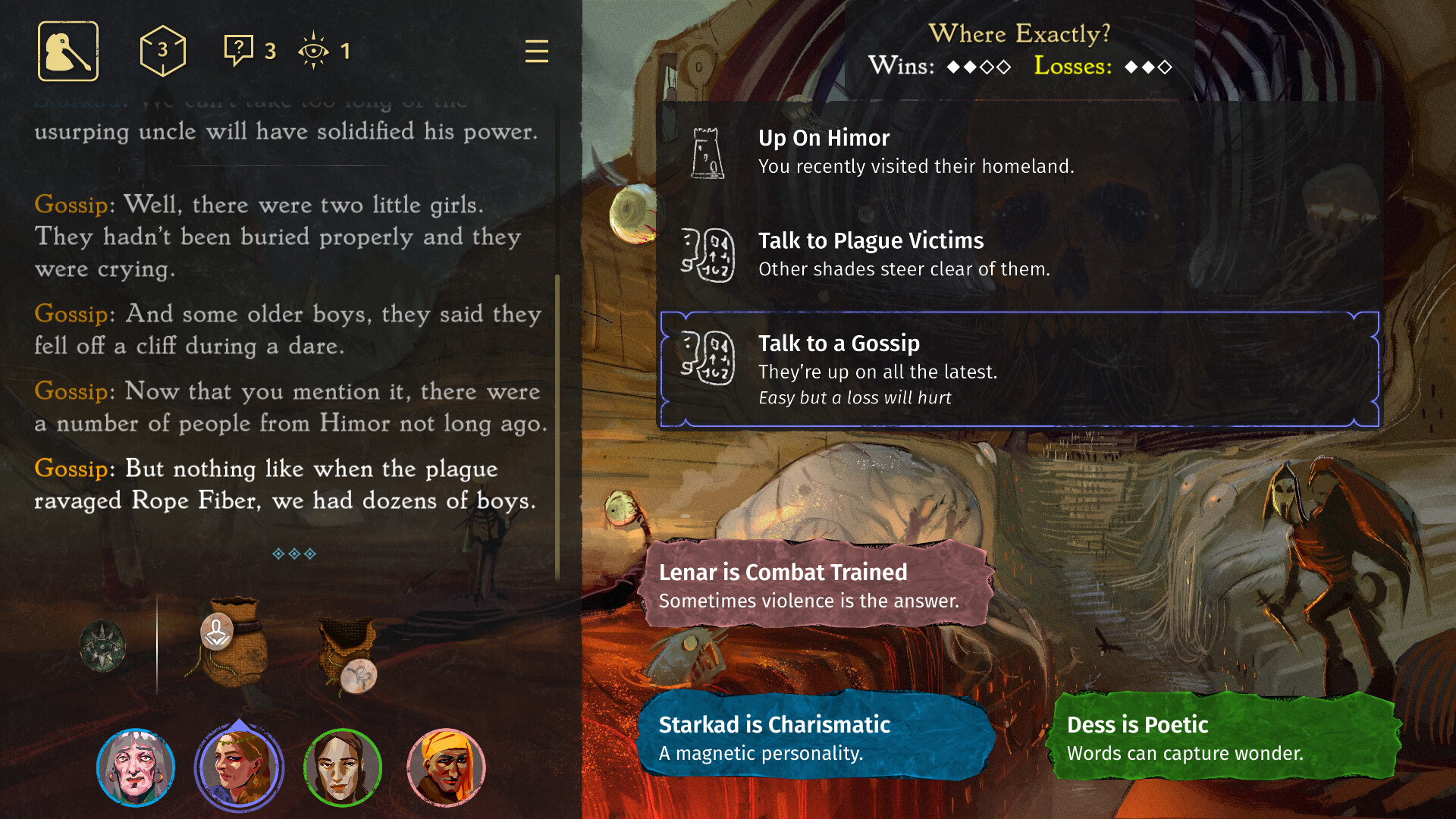
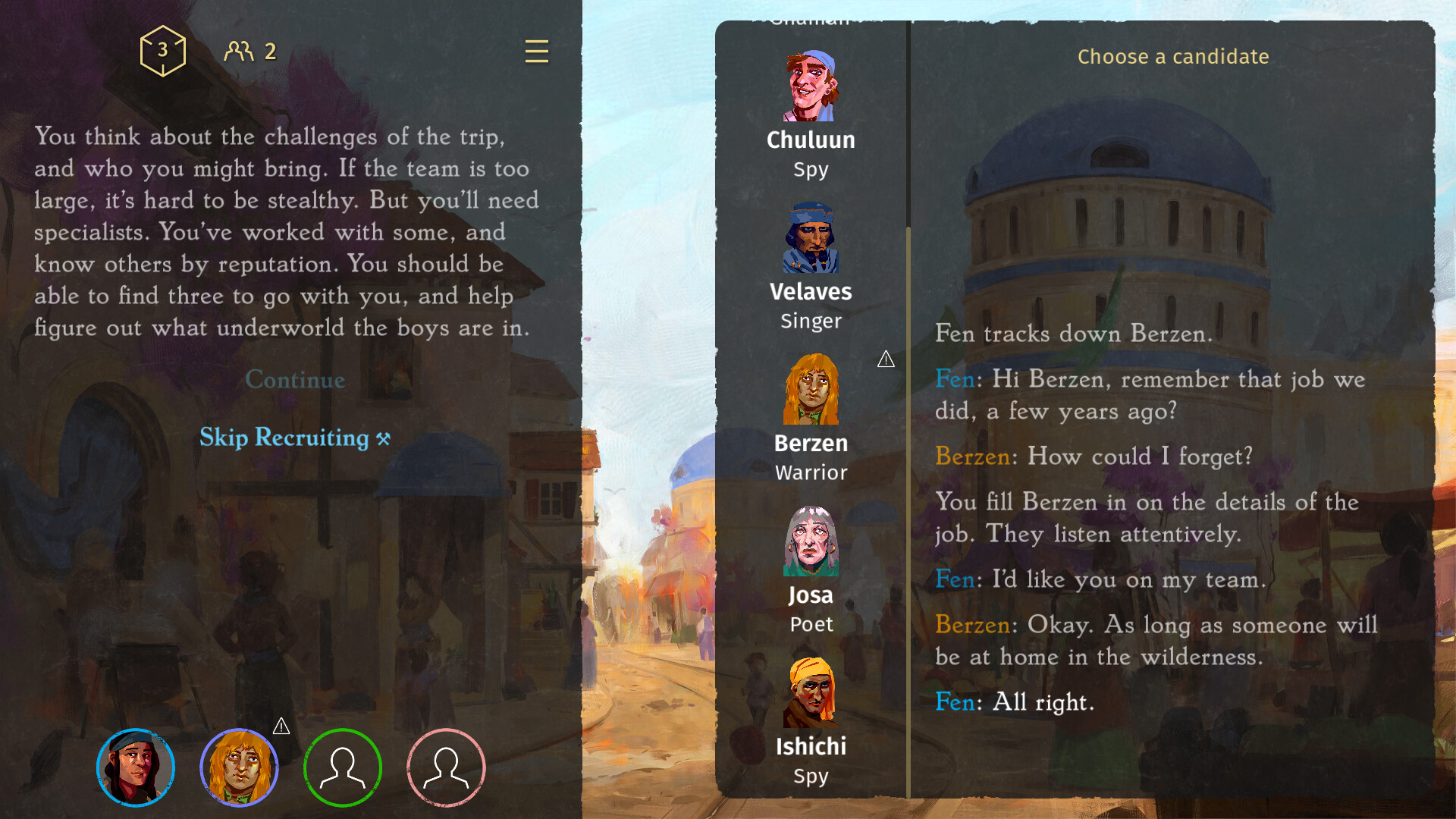
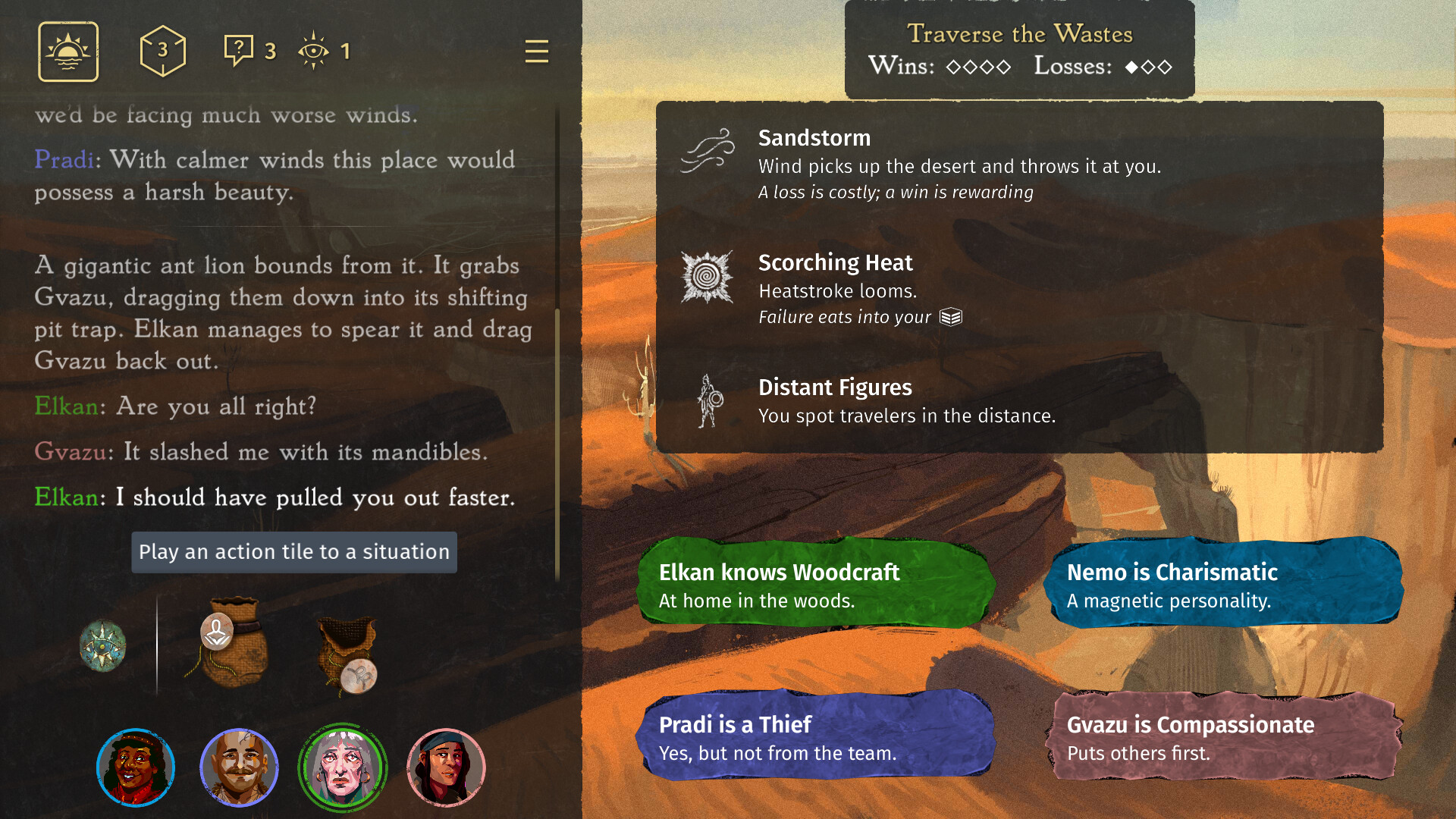
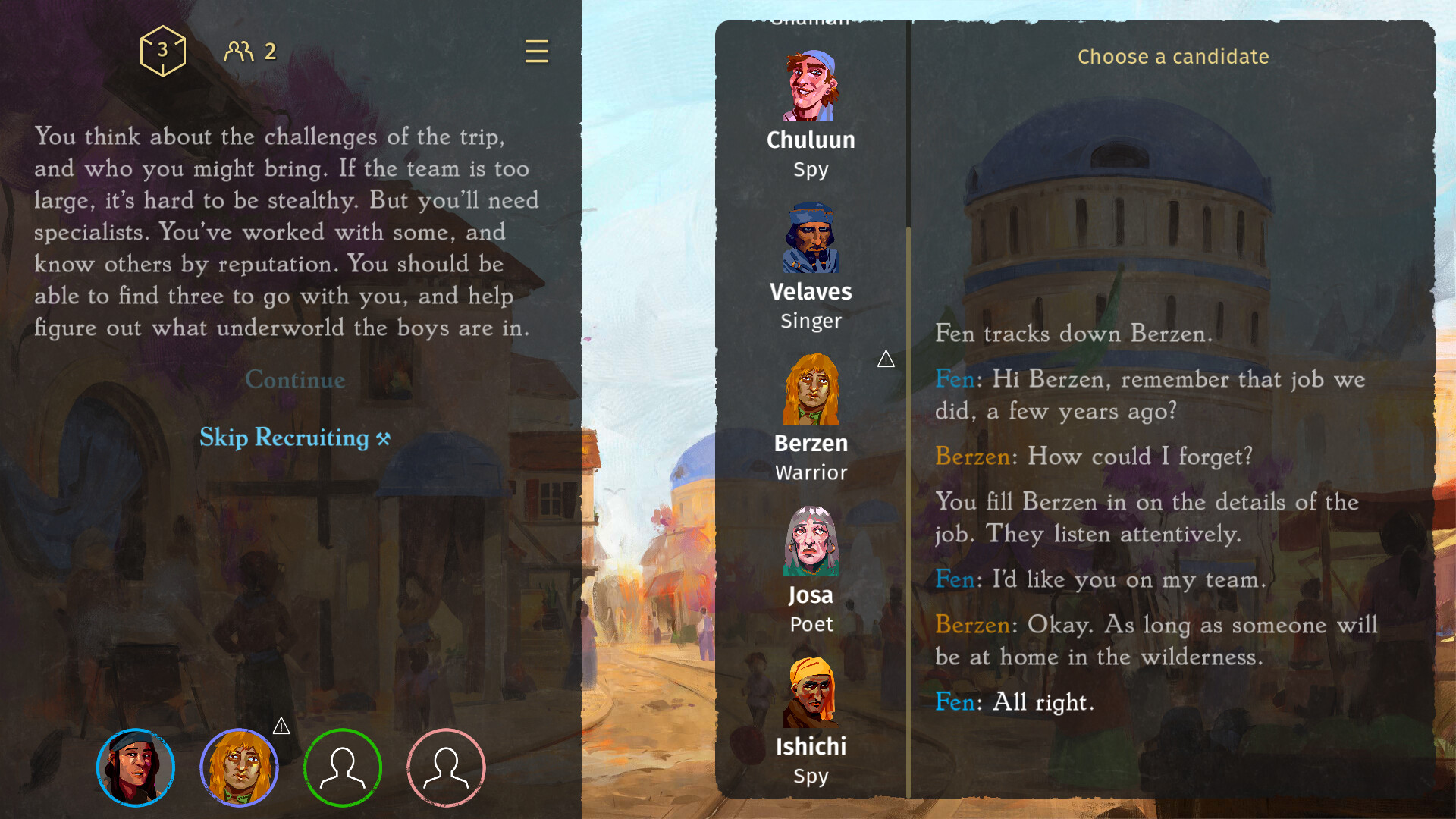
The thing is, as I mentioned before, Thousand Hells is incredibly random. While you can set your Mission, what happens during it, the options you have in encounters, the way events pop up and play out, and essentially everything about a run is up to chance. This could mean an unbalanced party. It might mean you’d have situations that could involve sailing, but nobody in the group who actually knows how to handle a boat. I did notice that I usually had some sort of warrior or rogue available to recruit, but then they might not be guaranteed to possess the traits that make them good at their professions. Because of all that, it doesn’t feel like Thousand Hells is a chronicle of an epic like King of Dragon Pass or Six Ages. While we are going on an adventure and taking on a task, the result doesn’t feel like as strong or interesting a narrative due to RNG and design prioritizing quick runs.
While I am not the biggest fan of exactly how random Thousand Hells can be, I do appreciate the incentives A Sharp built in to encourage someone to keep approaching Missions and Hells. In a way, it almost felt roguelike. It isn’t designed to be a long affair in the same way Six Ages is. I found I was usually done in about 45-60 minutes. If I did fail, I could retry it. When I’d succeed, more Missions and options would open up. So while some of the RNG can be discouraging, the overall progress we can make and execution can mitigate some of the elements.
Thousand Hells: The Underworld Heists is fine and has some of Six Ages tactical narrative feel to it, but the roguelike randomness and ease with which someone can find themselves in no-win situations does the concept a disservice. I wouldn’t be surprised if there are people who end up liking it more than past A Sharp titles because of the unpredictability! Likewise, I think those who prefer the more traditional approaches King of Dragon Pass and Six Ages offered might bounce off this one. It’s not bad! It just feels quite different due to the design choices.
Thousand Hells: The Underworld Heists is available on PCs via Steam.