|

The Lowdown
Pros: Casts an absorbing spell of intrigue, drama, romance and suspense, with a pinch of film-noiresque, gun-slinging action.
Cons: Action is mostly absent from this near-text-based romp, and the length, although substantial for an adventure game, is piddling on the CD medium - you won’t want it to end.
    |
One can draw many parallels - and just as many differences -
between the Sega CD and one of the most sought-after, most noteworthy
games produced for said Genesis add-on, Konami’s 1994 ‘cyberpunk’
adventure, Snatcher. Like its host console’s tenure of some two short
years, Snatcher’s duration is short and quite notably incomplete; but
where its parent peripheral’s hold was shaky and fated for obscurity,
the game’s hold to this day on players’ minds - and wallets - is far
more gripping (just check Ebay for proof of that). And like the CD-ROM
system’s library, Snatcher is a mixed bag of sights, sounds, ideas, and
gameplay experience; but, as cannot be said of the aforementioned
library, it’s also nigh-unanimously loved and lauded by those in the
know. While many say that Snatcher, with the illusion of freedom
granted by total stylistic immersion in a fairly point-and-click world,
is easily the system’s best offering and a pivotal development to the
industry, others, citing the same PC-game style and interface as
redundant and limiting, call it overrated.
This review is an attempt to give you the truest version of all these
truisms.
Snatcher was the brainchild of Hideo Kojima of Metal Gear fame, and
first appeared on the PC88 in 1988 (a NEC system). Since that time, it
has been ported to equally-defunct MSX Home Computer, NEC PC Engine
(Turbo Duo CD to us), Sony Playstation, Sega Saturn, and, of course, the
Sega CD, which remains the sole English version available. Its release
was no doubt not a wide and prosperous one, for it fell on the cusp of
the 32-bit console generation, but it has since earned a place in the
most-wanted books of many a gamer.
As said before, Snatcher is a ‘cyberpunk’ adventure, a genre with its
roots in such rabidly-loved films as Blade Runner. What does cyberpunk
mean, exactly? The basic formula goes like this: in the not-so-distant
future, a time of flying cars, man-made mecha-cities, and advanced
technological commodities, the threat to humanity from its own creations
outweighs our own danger toward ourselves. In the case of Snatcher, the
year is 2047, the place, Neo Kobe, Japan, and the menace comes from the
titular identity-swiping robots, complete duplicates of existing
persons, bent on replacing very important people in society (that’s the
actual criteria - must be a V.I.P. to be snatch-worthy). A specialized,
exclusive unit of the police force, known as JUNKER, has been formed to
combat this menace, and as amnesiac agent Gillian Seed, you’ve got to
snoop around, gather clues, and crack the string of whodunnits wide open
- and hopefully gain back all the memories you lost three years prior
that landed you in the job to begin with. Throughout the course of
Snatcher, you’ll interview informants and confidants, question and be
questioned, decipher clues and decrypt codes, and meet a bevy of
colorful characters - all of whom are suspect, even yourself.
Now, to all those who have seen Blade Runner: if this sounds familiar,
it’s because it most blatantly is. As should be obvious to you from the
get-go, EVERYTHING in Snatcher pays such deliberate homage to that
celluloid - and borrows so generously from a handful of others, such as
The Terminator and the like-entitled Invasion of the Body Snatchers -
that the originality of the game would come into great doubt, if it
weren’t for the originality of the presentation. Instead, thanks to the
expertly-woven murder mystery concocted by Kojima, the development of
the characters, and the solid delivery and progression of storyline
which forms the grand appeal of Snatcher, the player is never made
terribly aware of the influence of the source material. What we’re
treated to is a brilliant, never-before-seen and never-since-duplicated
package - a clever and new-feeling take on a fruit basket of
fan-favorite ideas, but as a video game in general, I would gauge it
about three parts sour grapes to seven parts sweet delights.
Why lower than most reviews? Well, Snatcher has a good foundation as a
detective story, but gameplay in a strictly menu-driven world comes down
to a whole lotta watching, listening, and reading - more like an
interactive novel than a game at times. Which it does very well -
Snatcher is full of exceptional, emotionally-charged voice acting (a
trait which, even in over ten years time, barely any other game outside
of Kojima’s own productions has bothered to learn from or at least
imitate), colorful, and oft-graphic, anime-influenced visuals with the
occasional real-time animation that more than satisfies when compared to
full-motion video of the time, and a suave, jazzy soundtrack that makes
the most of the Genny’s FM chip, even utilizing the Sega CD-specific
Roland Sound System for a multi-layered effect. With its gritty, gory
nature, crude (and hilarious) sexual humor and visual offerings for the
male audience, and abundant underworld overtones, one must wonder how
the game garnered a mere T for Teen rating. And let me be the first to
tell you, it’s a real mistake - you should be at least 15-16 years old
for this ride.
Although the writing and acting just smacks of talent and high
production values, the bulk of Snatcher still boils down to navigating
through static scenery, sometimes having to perform your array of
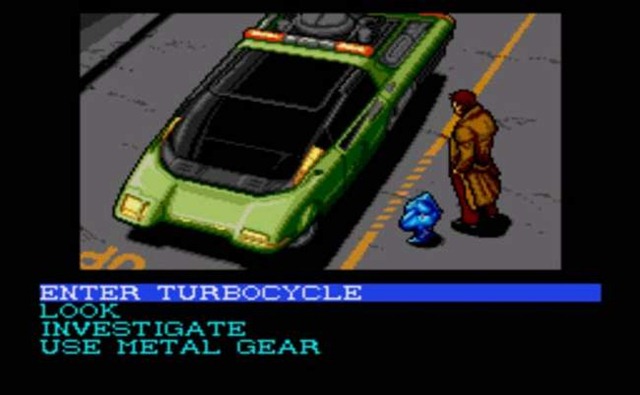
commands - Look, Investigate, Ask, Talk, Show Possessions, etc -
multiple times on the same objects and people to produce the desired
effect, and reading the copious amount of text that results from your
actions. However, with a story this good in a video game, this is more
of a privilege than the chore that a poor translation would have
provided, and when you get a scene of dialogue (not all that uncommon),
you’re in for a real treat. The best scenes stem from the bickering
banter between Seed and his Navigator, Metal Gear mark II, and with his
estranged wife Jamie - one exchange will have you reeling with laughter,
then a moment later, another will shatter the comedic atmosphere,
paralyze your mind and make your heart skip a beat or two.
What’s more the treat is what forms the action-oriented portion of the
game - the rare shooting sequences! Suddenly and usually without
warning, a sequence in which Gillian will have to draw his
standard-issue Blaster, aim in a 3x3 grid, and fire will occur (but
always use your judgment before you shoot - that’s the JUNKER way!) If
you’ve ever played the bonus game in Konami’s earlier title Sunset
Riders (SNES/Gen/Arcade), it’s basically the same concept - with center
as your neutral starting point, targets will appear on-screen, and you
must hold the proper direction and fire on them before they do so at you
and deplete your life gauge. The realism is heightened for those who
have Konami’s Justifier lightgun that came with the game Lethal
Enforcers (though I suppose Sega’s own Menacer would work), but it was
altogether an underused facet of the gameplay. They really ought to have
included more of them, but if you’re really hankerin’ to whip out the
pistol, you can always pay a visit to the Shooting Range at JUNKER HQ
for some target practice.
The BIGGEST beef you might have with Snatcher that hasn’t been told a
thousand times over might well be the ending. If you’re averse to
hearing even the most general and spoiler-free commentary, I kindly
suggest you scroll down past this paragraph (or if you’re mean, you can
just leave, you big meanie). Otherwise, consider yourself warned - the
game is sorely incomplete, more of a first chapter to at least a two- or
three-part story that will likely never see fruition. The last of the
ending segments also see a collapse in the balance of story versus
actual gameplay into a morass of long, less interestingly-revealed
events, nearly falling victim to most anime’s greatest pitfall - lack of
sensible pacing. This ticked me off royal, and having the wheels set in
motion for a greater leg of the journey only did so further. The
sappiness some of the final events is then cut startlingly short by a
rather serious observation - including the phrase, ‘the conflict has
just begun’. Who ends a game like that unless they mean to continue it,
honestly?!
Overall
So if you play, be prepared - at somewhere between 6-10 hours, and
the latter part of that estimate is assuming you run into trouble that doesn’t
get resolved right away by a walkthrough, Snatcher is altogether too short.
While the atmosphere achieves cinematic proportions in this game like it has
in few others, it is just as soon taken away, and you’ll be left with the worst
feeling of betrayal since Shenmue 2 - or to be chronologically correct, the
other way around. In any case, if you’d like some good mental exercise, some
truly involving character interaction, and excitement aplenty (barring the
confused wandering in which you’re sure to partake at one point or another),
Snatcher will be your very good friend for one very good, solid play-through.
- Katie Montminy
|
|